

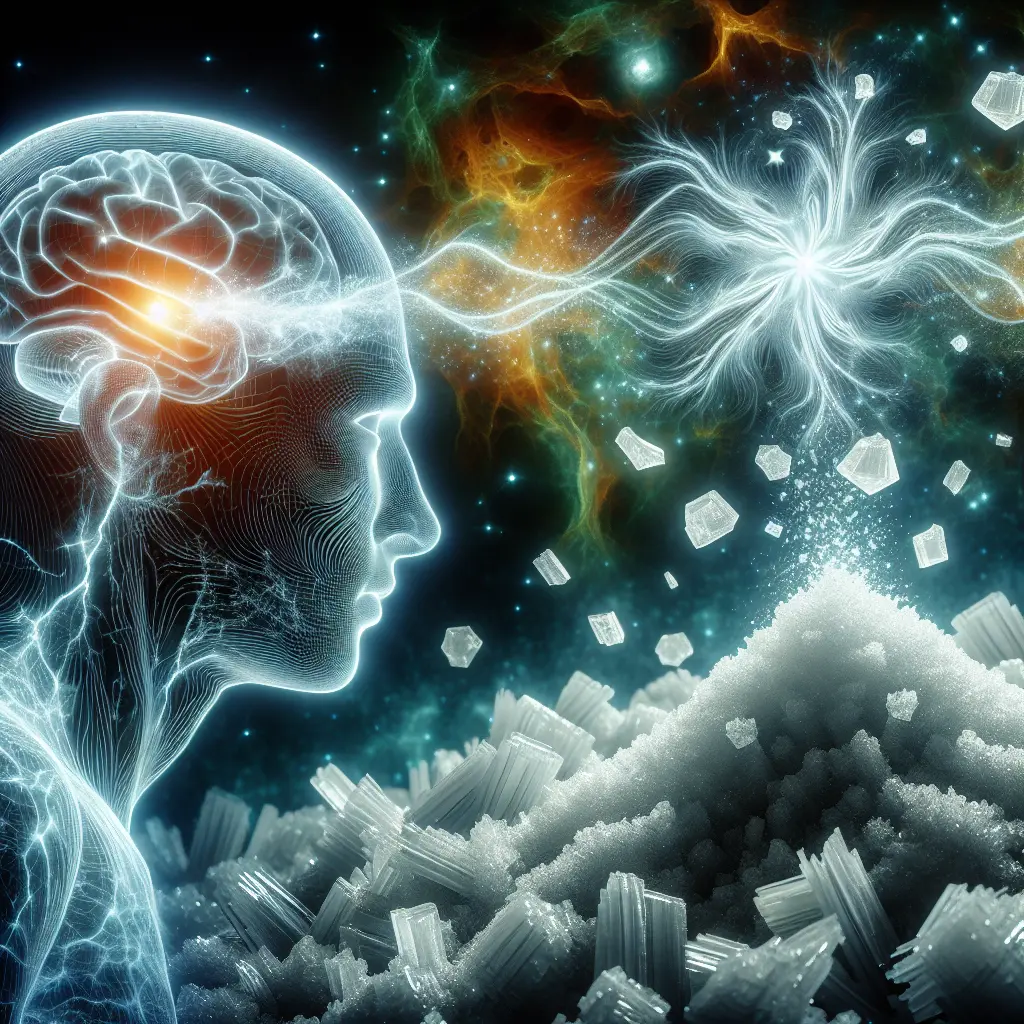
Crystals have long fascinated scientists and spiritual seekers alike, acting as windows into the mysterious relationship between matter and consciousness.
Recently, new explorations in crystallography have sparked a debate that could redefine our understanding of both science and the mind. At the heart of this discussion lies a provocative demonstration: the real-time alteration of xylitol crystal patterns through focused human intention, observed under a microscope.
The Experiment: Consciousness Meets Crystallography
A striking claim emerged: human thought could directly influence the growth and structure of xylitol crystals. Under microscopic observation, these crystals reportedly began forming recognizable patterns—shapes reminiscent of animals, landscapes, and other meaningful imagery—when participants directed their focus and intention toward them. Such observations suggest a dynamic interplay where consciousness may shape the physical manifestation of crystals in real time.
Challenging Materialist Science
Traditionally, materialist science has viewed matter as unaffected by non-physical forces like thought or intention. However, these crystallography experiments challenge that assumption by hinting at a direct mind-matter connection. If confirmed, this would upend established scientific paradigms, inviting new models to explain how subtle energies might interact with the physical world.
Morphic Resonance: A Theoretical Framework
To explain these phenomena, the concept of morphic resonance, popularized by biologist Rupert Sheldrake, is invoked: Morphic resonance posits that patterns and behaviors are influenced by fields that transcend time and space. These "morphic fields" carry information from past forms or experiences and can guide the development of both living organisms and crystals. Within this framework, focused human intention could activate or tune into these fields, influencing the formation and structure of crystal patterns.
Implications for the Study and Use of Crystals
If consciousness can indeed affect crystal formation, the implications extend far beyond the laboratory. For personal growth, this aligns with age-old practices where crystals are used for meditation, healing, and intention setting. It supports the idea that our minds may actively shape the energy or structure within crystals.
From a scientific perspective, new research directions could explore how thoughts, emotions, and group intentions might impact not just xylitol, but other crystalline substances as well. Holistic healing therapies involving crystals could gain renewed scientific interest as we better understand the mind-matter connection.
The Ongoing Mystery
While more rigorous research is needed to validate these findings, such experiments keep alive the question: Are crystals passive objects, or do they interact with us in subtle ways that science is only beginning to explore?
To dive deeper into this topic and view the original experiment details, visit the article here.
Exploring Crystals: Mystery Meets Mind
May your journey with crystals be filled with discovery, intention, and a touch of magic.
As research into consciousness and crystallography advances, it continues to challenge long-standing assumptions and inspires both scientific inquiry and personal exploration.
Whether in the lab or in daily life, the dynamic between mind and matter remains a profound mystery worthy of further study.
With open curiosity and focused intention, who knows what new patterns may emerge in both crystals and consciousness?



Leave a Comment